
Is Your Child Afraid to Sleep Alone?
A proven, step-by-step program for sleep anxiety developed by a child psychiatrist to help school-aged children and pre-teens (ages 5–12) sleep independently with confidence
Whether your child:
- calls you back repeatedly at night
- refuses to stay in their bed
- feels scared when the lights go out
- or insists on sleeping with you
there is a gentle, proven way to help them feel safe and confident on their own.
Bedtime Hero is an interactive, animated program developed by a child psychiatrist that guides your child–step by step–toward sleeping independently.
Give your child the confidence to fall asleep on their own.
Developed by a child psychiatrist • Based on real clinical methods • 100% Risk-Free Guarantee
See How Children Build Confidence
Learning to overcome bedtime fears is an important step in building confidence and independence.
As a child psychiatrist with over 30 years of experience, I developed a method to help school-aged children learn to sleep alone feeling calm and confident.
"Now it's all good and I can do it all."
"Do you feel pretty proud of yourself now?"
"Yup!!"
- Veronica, age 9 (after completing the program)
Let Your Child Try Bedtime Hero Free
Let your child try the first module free. No credit card required.
Your trial includes the Free Bedtime Confidence Guide and accompanying practical guidance.
The Child Afraid to Sleep Alone
It started innocently enough .. Your child was afraid to sleep one night for some reason - a nightmare, something unsettling during the day, a scary story, a video .. You comfort them, but then it continued, one night after another. They need you to stay with them until they fall asleep, and they notice the moment you try to leave.
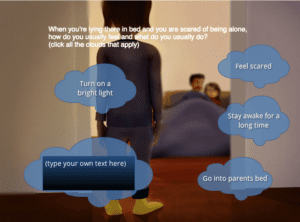
Bedtime stretches longer. Your child may lie awake for an hour or more and seem tired the next day.
The fears vary: the dark, noises in the house, bad dreams, intruders, or imaginary threats.
Maybe your child started coming into your bed during the night without you even knowing (or you were too tired to deal with it), and the next morning .. Surprise! There they are!
If it goes on long enough they may refuse to sleep in their own room altogether. You may have tried firmness, rewards, or compromises, but nothing sticks.
Meanwhile, the stress builds. Arguments, tears, and disrupted sleep leave you frustrated .. and ready for a real solution.
Understanding Sleep Anxiety in Your Child
Most children who are afraid to sleep alone are not being difficult. They are experiencing a normal form of anxiety that can be addressed with the right approach.
What It Isn’t.
Bedtime anxiety is not the same as:
- Physical discomfort (too hot, too cold, illness, noise, etc.)
- Wanting to stay up later or bedtime resistance
- General worries about school or friendships
- Hyperactivity or ADHD-related restlessness
These need different solutions.
What It Is
At bedtime, the mind becomes quiet. And imagination takes over.
Children have vivid imaginations (much stronger than adults) but limited life experience. They can’t easily tell what is truly dangerous and what isn’t. So when they hear a scary story or see something frightening, it can feel very real .. especially at night.
This is why fears grow in the dark and why your child seeks safety with you.
Learning to face these fears is an important step toward confidence and independence. With the right approach, your child can learn to feel safe. And fall asleep on their own.
How Common Is It?
Fears at bedtime are very common1. A study by Gordon, King, Gullone, Muris and Ollendick2 (2007) found that 64.2% of children and adolescents reported having nighttime fears. Another study (Owens, Spirito, McGuinn and Nobile3, 2000) reported the prevalence of significant sleep problems in children to be 37% in the general population. These are HUGE numbers. It means that 2 out of 3 children will have fears at bedtime at some point in their lives, and that 1 out of 3 children will have significant issues about going to sleep.
Want a simple way to start helping your child?
The Fear of Sleeping Alone Results From Three Types of Problems
Specific Fears
This is by far the most common reason for children being afraid to sleep alone. Based on descriptions from my patients over the years, there are 7 common fears that are the source of most nighttime anxieties (more about this below).
Separation Anxiety Disorder
The primary issue in separation anxiety is that a child feels insecure and fearful when they are on their own. The anxiety is not limited to bedtime and often occurs during the day in a variety of situations. Here are the DSM-5 (the Diagnostic and Statistical Manual of Mental Disorders, 5th Edition) criteria for the diagnosis of Separation Anxiety Disorder. Note that each Category (A,B,C and D) must exist to make the diagnosis.
A. Developmentally inappropriate and excessive fear or anxiety concerning separation from those to whom the individual is attached, as evidenced by at least three of the following:
1. Recurrent excessive distress when anticipating or experiencing separation from home or from major attachment figures.
2. Persistent and excessive worry about losing major attachment figures or about possible harm to them, such as illness, injury, disasters, or death.
3. Persistent and excessive worry about experiencing an untoward event (e.g., getting lost, being kidnapped, having an accident, becoming ill) that causes separation from a major attachment figure.
4. Persistent reluctance or refusal to go out, away from home, to school, to work, or elsewhere because of fear of separation.
5. Persistent and excessive fear of or reluctance about being alone or without major attachment figures at home or in other settings.
6. Persistent reluctance or refusal to sleep away from home or to go to sleep without being near a major attachment figure.
7. Repeated nightmares involving the theme of separation.
8. Repeated complaints of physical symptoms (e.g., headaches, stomachaches, nausea, vomiting) when separation from major attachment figures occurs or is anticipated.
B. The fear, anxiety, or avoidance is persistent, lasting at least 4 weeks in children and adolescents and typically 6 months or more in adults.
C. The disturbance causes clinically significant distress or impairment in social, academic, occupational, or other important areas of functioning.
D. The disturbance is not better explained by another mental disorder, such as refusing to leave home because of excessive resistance to change in autism spectrum disorder; delusions or hallucinations concerning separation in psychotic disorders; refusal to go outside without a trusted companion in agoraphobia; worries about ill health or other harm befalling significant others in generalized anxiety disorder; or concerns about having an illness in illness anxiety disorder.
Post-Traumatic Stress Disorder
The underlying problem here is that a child has experienced a seriously traumatic event, such as physical abuse or a life-threatening accident. If the issue has not been resolved, frightening images related to the event will commonly resurface as the child is falling asleep causing anxiety in the child at bedtime.
The Goal
The goal is not merely for your child to stay in their own bed at night, but for them to feel comfortable, confident and unafraid of sleeping on their own.
The 7 Common Bedtime Fears in Children
- Fear of being alone
- Fear of the dark
- Fear of the closet or under the bed
- Fear of sounds in the house
- Fear of someone breaking in
- Fear of waking in the night
- Fear of bad dreams or scary stories
(If your child suffers from frightening dreams, you might also want to check out this article on How to Deal with Nightmares in Children)
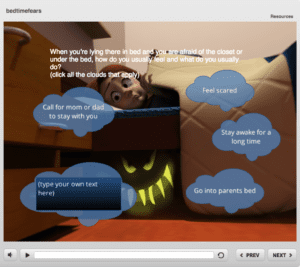
As you can see, Separation Anxiety Disorder directly relates to both the fear of being alone and the fear of waking in the night. Post-Traumatic Stress Disorder relates to the fear of bad dreams or scary stories, although the scary dream or story in the case of PTSD is based on a real event.
Most often, however, the child who is afraid to sleep alone has a specific fear and nothing more. Scary videos or movies, creepy stories told by other children, news about deaths or traumatic events, frightening weather, bad experiences, etc, can all trigger bedtime fears.
If you’re seeing your child in this list, you don’t have to guess what to do next.
Start with a simple, structured plan right away.
The Usual Advice (What Works and What Doesn’t)
Many common suggestions for bedtime fears sound helpful, but some can actually make the problem worse over time. See if you can tell which ones are recommended, and which ones are not ..
Answer: Recommended, but limited.
Why: The amount of sleep recommended is: Preschoolers (3-5 years) 11-12 hours; Early school-aged (6-9 years) 9-11 hours; Late school-aged (10-12 years) 8½-10 hours; Adolescents (13-18 years) 6½-10 hours1. Good advice, but does not address the child’s fear of sleeping alone.
Answer: Recommended, but more is needed.
Why: Good advice, but does not address the child’s fears.
Answer: Recommended, but not sufficient on its own.
Why: Good advice, but does not address the child’s specific fears.
Answer: Not Recommended
Why: This can unintentionally teach your child they need you present to feel safe. A child often becomes hyper aware of any sound or movement that indicates the parent is about to leave.
Answer: Not Recommended
Why: This can unintentionally reinforce the idea that monsters are real. Instead, children need to understand that monsters and zombies really do not exist.
Answer: Recommended
Why: This will not usually solve the problem by itself. However, if it can be combined with a program that helps the child overcome their fears and develop confidence, such as Bedtime Hero. The floor bed can then be moved gradually closer to the child’s own bedroom.
Answer: Recommended
Why: This is one of the core strategies used in Bedtime Hero.
Answer: Not Recommended
Why: This reinforces a pattern of avoiding scary things rather than facing them and dealing with them. Children need to learn that their bedroom is actually a secure and comfortable place and that a scary shadow is just a shadow, nothing more. This approach is built into my Bedtime Hero program.
Answer: Not Recommended
Why: In many cases, this can persist for years. When not addressed, bedtime anxiety may also increase vulnerability to other forms of anxiety. For this reason, I believe it is in the child’s best interest to learn how to overcome their fears, build their self-confidence and enjoy their success.
Answer: Not Recommended
Why: Fear is not under a child’s control. Consequences can increase anxiety rather than reduce it.
Answer: Recommended
Why: As long as rewards are small and reasonable this can help orient a child towards success and motivate learning. This approach is included in the program.
Answer: Not Recommended
Why: If a child is simply overactive or experiencing physical discomfort this may be helpful. However, it is actually quite difficult to "relax away" a specific bedtime fear.
Answer: Recommended, but only if they are very dim.
Why: Leaving the bedroom door open a crack or a small plugin night lite can be useful, but avoid bedroom lamps or overhead lights because this can actually interfere with the natural production of sleep-inducing melatonin in a child’s brain. This strategy is built into the Bedtime Hero program.
Answer: Not Recommended
Why: Don’t allow your child to become dependent on these parent substitutes.
Answer: Recommended, as additional support.
Why: Ok, but only as a supplement to other strategies aimed at eliminating fears.
Answer: Recommended
Why: Definitely, unless your child has ADHD when their stimulant medication may actually help to settle them before bed.
In general, approaches that gradually build independence tend to be more effective than those that increase reliance on a parent.
If this sounds familiar, you’re not doing anything wrong.
Most advice sounds reasonable, but without a clear structure, it’s hard to apply consistently.
Start with a clear step-by-step approach.
Not sure if Bedtime Hero is right for your child?
Let your child try the first module free. No credit card required.
What Your Child Really Needs
Your child’s brain is incredibly powerful.
Children learn faster than adults. They use imagination easily and creatively. In many ways, it’s like they have a powerful mental “engine”, but haven’t yet learned how to use it effectively.
The goal is not just to reassure your child.
It’s to help them learn how to feel strong and confident on their own.
When children discover their own strategies for feeling good instead of fearful, they build confidence that carries into many other areas of life.
How to Help Your Child Sleep Alone - Use a Method That Works
This is the empowering systematic approach I developed and used in my clinical practice with many children experiencing bedtime anxiety.
It is now built into the Bedtime Hero program—an interactive experience that guides your child step by step through the same process.
The Bedtime Hero Program
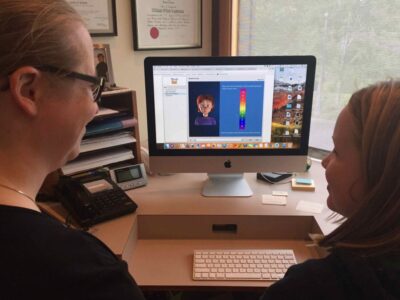
Bedtime Hero is an interactive online program in which your child is guided, using voice and animation, through a structured series of steps.
Your role is simple: to support and encourage your child as they work through the process.
Unlike most advice, this program actively engages your child in solving the problem themselves.
They become part of the solution — and begin to take ownership of their success.
Why This Approach Is Different
Many approaches place the responsibility on the parent to manage the situation.
This program shifts that process to the child in a guided and supported way.
This shift makes a huge difference.
Results from Clinical Practice
In my clinical work, this step-by-step approach led to significant improvement in over 90% of children with bedtime anxiety, often within just a few sessions.
Ready to help your child build confidence at bedtime?
See how the complete Bedtime Hero program helps children feel calmer and more confident sleeping on their own.
Get bedtime back on track — so your child goes to school confident and well-rested.
Bedtime Hero Reviews
Parent ratings: 4.6 out of 5 stars (based on 40 reviews)
Here's what other parents have to say ..
About Dr Lauderdale

Copyright © 2026 by W. Mark Lauderdale MD FRCPC
All rights reserved.
A Parent’s Experience
"Hi Dr. Mark - Just wanted to send some feedback and a quick word of thanks for the Bedtime Hero program. For months, we have struggled to make any progress getting our 7 year old to sleep on her own. She becomes extremely anxious at bed time and everything we tried had little motivation for her - no reward or threat to take something away had any impact on her fear level. It just was real and we all couldn’t figure out any strategies to make improvement.
I figured there had to be some sort of therapy we could try and upon a quick Google I found Bedtime Hero. My daughter was super excited to try it cause it seemed cool, she desires to be better at bedtime, it was something we could do together and frankly, it just gave us a different way to come at this problem.
The first night she rated herself a level 10 anxious, and I would have to agree. She wasn’t even bluffing - she was terrified of sleeping on her own. Two nights in? She rated herself a 0. ?! Don’t get me wrong, we have a long way to go, but look at her confidence jump and she’s HAPPY. I can’t recall a day where she’s been happy in her bedtime routine. We love the tapping and thinking of good thoughts. This program resonated with her!
Wish us luck on continuing the journey, but I wanted to stop and say THANK YOU for this tool."
- Katie T.
References
- Owens, Judy A, and Mindell, Jodi A. Taking Charge of Your Child's Sleep. 2005. New York:Marlowe & Company.
- Gordon J, King N, Gullone E, Muris P, Ollendick TH. Nighttime fears of children and adolescents: frequency, content, severity, harm expectations, disclosure, and coping behaviours. Behaviour Research and Therapy 2007 Oct; 45(10): 2464-72.
- Owens JA, Spirito A, McGuinn M, Nobile C. Sleep habits and sleep disturbance in elementary school-aged children. Journal of Developmental and Behavioral Pediatrics 2000 Feb; 21(1): 27-36.